
AI Can Write Your Business Plan. Who’s Going to Run It?

Like almost everyone in 2026, I enjoy the benefits of AI in much of my daily life. It helps me plan family vacations, gives me good workouts that meet my fitness goals, and has some pretty good suggestions for the next book, series, or movie I should check out. But when it comes to using AI for work, I’ve been a bit more resistant.
I recently asked AI to produce a basic business plan for a hypothetical small professional services firm looking to grow its client base. In less than a minute, it produced a neatly organized five-page plan full of exciting ideas and a timeline for execution. It laid out a new social media strategy, a refreshed sales funnel, and a quarterly email campaign. It also suggested a handful of strategic partnerships to pursue.
Honestly, I was impressed. But as I dug deeper, I found myself asking the same question every business owner struggles to answer:
Who is going to do all of this?
Two years ago, I wrote about why effective strategic advice comes from lived experience, not hypotheticals in business books. Even the best advice is useless if it doesn’t work within the realities of your business. The same is true for AI outputs.
As the Chief Strategy Officer of LVL-Up, I’ve talked with business owners who want to rely on AI tools to fill gaps on the team. For marketing, operations, sales — any and every department, really. And I understand the appeal.
AI is fast, affordable, and at your fingertips 24 hours a day. You no longer have to wait for a meeting with your team. You can “meet” with AI at 11 p.m., when you finally have a moment to look beyond the day-to-day must-dos and think about growing your sales, or at 4 a.m. when your business is keeping you awake in bed.
LVL-Up uses AI, too. But as support in our departments, not as the department itself. AI outputs and artifacts can speed up first drafts, produce mock-ups, and deliver plans in minutes. But if you don’t have someone with the expertise on how to apply these plans, how to achieve these goals, you are no further along in practical application than you were with the “hypothetical advice” and “quick fixes” touted in so many of the business books that leave us short of the finish line. What’s more, if you don’t have time to think up a plan, how will you have time to execute one?
And for some business owners, AI can create a new kind of analysis paralysis. It’s easy to spend hours asking questions, refining plans, and generating new ideas without ever implementing any of them.
AI will give you an answer, but an answer isn’t the same as an outcome.
A Plan Is Just the Beginning
Let’s look at a real-life example: cooking dinner. How can AI take over this home “department”?
First, let’s review the three stages to effective learning:
- Understanding and completing a task
- Understanding and completing the task and its associated tasks
- Incorporating the task and the associated tasks into your process
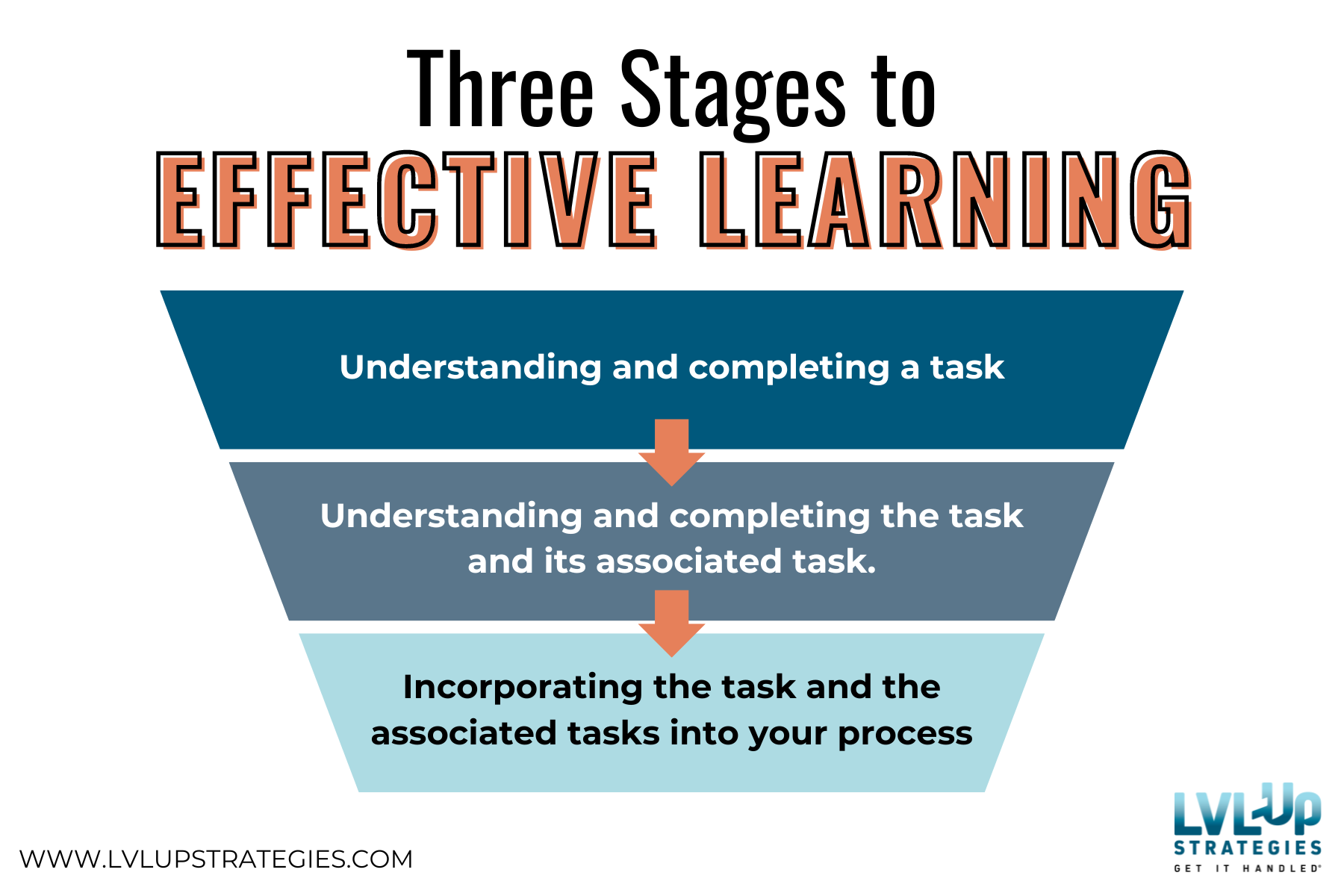
I’m interested in learning to cook by practicing at dinner. My favorite AI tool can tell me what to cook for dinner and provide me with a recipe once I input my pantry ingredients, which gets me through stage one.
Maybe I can figure out how to get AI to shop for me, but it can’t cook and clean up the kitchen. And it definitely can’t make sure this happens night after night without me having to think about it. Stages two and three still mostly depend on me.
With cooking, AI can assist with some tasks, but it cannot handle the whole job.
The same is true for many business tasks. AI can give you a 20-page plan on growing your LinkedIn following, but you still need someone to assess the quality of the content it suggests, make sure the plan aligns with your specific goals in practice, connect to publishing platforms, and align posts with your other marketing messages — not to mention having a human ensuring your planned posts don’t sound oblivious in the context of real-world events.
The real work often begins after AI gives you the answer. Posting three times a week on LinkedIn is one thing. Building a consistent brand voice that engages followers and supports your sales goals is another level.
Real progress happens when the plan is in the hands of people who understand your business, can manage the moving pieces, and know how to make the work sustainable.
But before you try and figure out how to implement AI’s recommendations, there’s another important question to ask:
“Are they the right recommendations in the first place?”
Use AI with Human Oversight
AI is very good at presenting what looks like an easy and obvious solution. My five-page business plan was polished, logical, and straightforward. But would I actually recommend that plan to a client? Not without asking a lot more questions.
For example, AI might suggest targeting a new type of customer without knowing that you’ve tried that before and it wasn’t profitable. Or it might recommend an entirely new sales strategy without realizing that most of your business comes from referrals through a handful of long-standing relationships. Your team will know if the output is aligned or way off track because they have the experience to make that evaluation.
It’s similar to a point I made two years ago about business books. Authors offer plenty of concepts and good ideas, but they don’t know your business. The same is true with AI, no matter how much background information you feed it. The hypothetical can only get you so far when trying to grow your business.
I’m not saying you need to stop using AI for business. Use AI to generate ideas, explore possibilities, and save time. Just be careful not to confuse a good-looking plan with a strong strategy. Assign a manager on your team to question the outputs, challenge shaky recommendations, and decide which parts make sense to test and which to throw out.
Answering these questions can help:
- Does this plan align with my actual business goals?
- Do the content and messaging reflect my brand?
- Do these recommendations make sense for my market, budget, and team’s capacity?
- Have I reviewed the details for accuracy and consistency?
- How will I measure results and make adjustments along the way?
Break the plan down into manageable steps, figure out who’s responsible for what, and make sure the work gets done by assigning tasks to people with due dates in your project management platform. Make the plan real, actionable, accountable.
Artificial intelligence can help you organize your work, set deadlines, and track progress. But it can't hold you accountable for getting things done. When a client or manager is waiting on you to deliver, you are more likely to complete the work and do it well. You don’t want to let them down. But when we are working on ourselves or our own business, with no one to disappoint but ourselves, we are more likely to let things slide.
Your Business Is Personal To You
The saying, “It’s just business, it isn’t personal” doesn’t often apply to business owners. And you need the support of a team that will take it personally with you. At LVL-Up, our team brings more than technical skills to the table. We often hear that we have changed the lives of our clients, opened doors they didn’t even know were options. If your input to AI is limited because of what you believe to be possible, your output will be limited too.
We are Eligible Family Members (EFMs)—the spouses and family members of Foreign Service employees and military personnel. We’re accustomed to adapting to new environments, learning unfamiliar systems, and finding solutions when there isn’t an obvious playbook.
I’ve experienced this firsthand through multiple overseas moves. I’ve relied on plenty of tools along the way, from translation apps to expat forums. And while they’re incredibly helpful, they only get you so far. A translation app can help you communicate with a landlord, but it can’t tell you which questions to ask to get a fair deal or to navigate a complicated lease. That’s where lived experience, recognizing patterns, and knowing what pitfalls to look for really matters.
I see a lot of similarities with AI. It’s a great resource for getting information and exploring ideas, but you still need to know how to apply that information to your own circumstances.
That ability to adapt, ask the right questions, and figure things out when there isn’t an obvious answer is something our entire team brings to LVL-Up. It shapes how we work with clients. We don’t just look at the task in front of us. Instead, we consider how it fits into the bigger picture, what makes the most sense for your business, and what it will actually take to gain progress.
So, who’s going to do all of this?
You don't have to figure it out alone. Whether you’re starting with an AI-generated plan or just have a list of ideas you haven’t had time to tackle, we’d love to help. Schedule a free discovery call and let’s talk about how you can #GetItHandled.


